
From Meditation to Action: Using the Superconscious Power in Daily Life
For Clear Decisions, Right Action, and Deeper Understanding

Normally, the superconscious is touched only in meditation.
Whenever you need clarity, when you are faced with decisions, confusion, or trying to understand what is unfolding in your life, you sit for meditation. You calm the mind, raise your energy, and gradually touch that higher state of awareness.
In that space, you begin to see more clearly. You understand what is actually happening, what your role is in the situation, what lessons are unfolding, and what the right course of action is.
But once meditation ends, you return to your normal conscious state.
From there, you rely on your conscious mind, using logic, past experience, and emotional balance to make the best possible decisions. This works to a certain extent, especially for those who have already developed some level of inner stability and clarity in their thinking, and are sincerely trying to act rightly in life.
And yet, this approach has a limitation. A deeper possibility exists.
What if you did not have to depend only on meditation to access the superconscious?
What if that clarity could be available to you even while you are actively living your day—while working, speaking, deciding, responding?
Because in truth, that is when you need it the most.
There is a way to do this. Below is a step-by-step process you can work with as you gradually build your capacity.
Step 1: Choose a clear path to the superconscious
You need a meditation practice that gives you a direct and repeatable way to move beyond the restless mind.
I practice Hong Sau meditation, as taught by Paramhansa Yogananda. What makes it powerful is its clarity. It provides a structured yet natural way to move inward, without forcing the mind.
There may be other valid paths, but the important thing is to choose one method which clearly leads you to superconscious state and stay with it long enough for it to deepen within you.
Step 2: Do not leave the conscious mind behind
This is where a subtle but important shift is required.
As your awareness begins to rise in meditation, the conscious mind is often left unattended. When that happens, one of two things usually occurs:
- Either awareness drops and the mind becomes dull or sleepy.
- Or the mind returns to its habitual patterns—planning, revisiting the past, or forming sharp and reactive responses toward people and situations
Neither of these helps.
The conscious mind must be brought along and given a role.
During meditation, be actively engaged in the process. Be aware, moment by moment, of the process. Direct your conscious mind with attention and willpower.
In the Hong Sau practice, for example, there is a phase of calming and focusing the mind and a phase of resting in deeper awareness. In both phases, the mind is not left idle. It is continuously involved in the exact action required in that moment.
If the mind is left idle, it returns to its comfort patterns. If it is engaged, it begins to align with higher awareness.
This requires effort. It requires sustained willpower.
And it is this sustained willpower that gradually creates the pathway through which the superconscious begins to express itself in your conscious life.
Step 3: Build consistency
Intensity with willpower is not enough; regularity is equally important.
Practicing daily, with awareness and involvement, slowly trains the system. Over time, the connection to higher awareness becomes more stable and accessible.
Without consistency, the experience remains unstable. With consistency, it becomes dependable.
Step 4: Create moments during the day
Do not limit your practice to a single sitting.
Throughout the day, create small openings where you reconnect, even for one or two minutes.
Pause. Bring your awareness inward. Practice “Hong Sau” briefly. Then continue with your activity.
Do this quietly, without drawing attention. Let it become natural and integrated into your routine.
These small moments are important. They begin to dissolve the separation between meditation and daily life.
Step 5: Allow the transformation to unfold
With time, a shift begins to happen.
The superconscious becomes easier to access. The transition becomes quicker. The effort becomes lighter.
More importantly, your conscious mind itself begins to change.
It starts to reflect the qualities of the superconscious such as greater clarity, reduced reactivity, and a more intuitive sense of right action.
This is not a sudden change, but a gradual and continuous process. And once it begins, it keeps deepening.
What this really means
It may appear that the superconscious has come down into your daily life, but in reality, your conscious mind is being elevated.
As this happens, you no longer depend only on meditation to find clarity. Your daily thinking, decisions, and responses begin to arise from a higher level of understanding.
Meditation becomes your pathway to further expansion of your consciousness. This is what true spiritual evolution is.
It is not confined to moments of meditation, but expressed in how you understand situations, the role you play in them, and the actions you choose in everyday life.

Amrita Ghosh
YogiEvolve
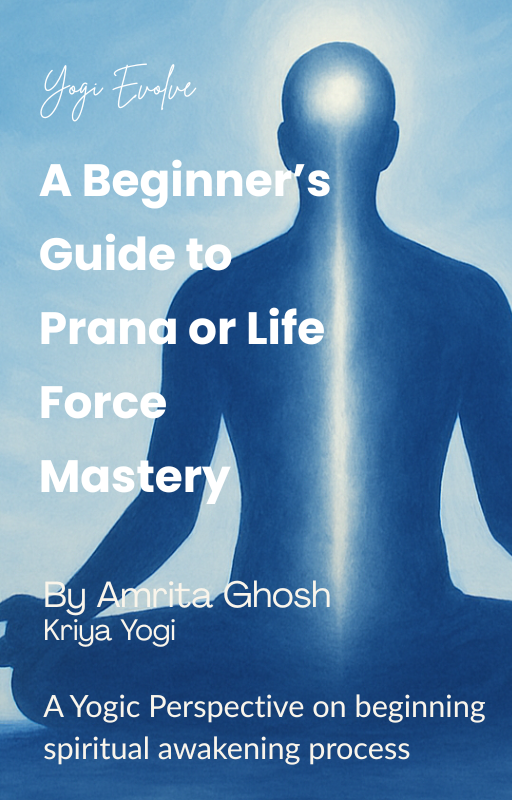
Your first step toward inner awakening — a yogi’s guide to transforming energy & life.
Based on the teachings of Paramhansa Yogananda.
Now Available at Amazon Kindle
Deepen Your Practice with the Companion Workbook
A guided companion workbook designed to deepen your experience of A Beginner’s Guide to Prana or Life Force Mastery.
Explore More Post from the Author
What Is Kriya Yoga? Understanding the Kriya Yoga Taught by Paramhansa Yogananda
Kriya Yoga has become widely known through Paramhansa Yogananda’s Autobiography of a Yogi. Yet today, many different teachings and practices are offered under the same name. How can a sincere seeker distinguish between them—and understand what Yogananda actually taught and promised?
The Five Gears of Spiritual Growth
The Five Gears of Spiritual Growth I watched thousands of seekers enter a spiritual organization with great enthusiasm. Of those thousands, perhaps only two or three remained steadfast, and even among them, perhaps only one experienced deep, sustained spiritual transformation.Why do so many sincere seekers begin with dedication, yet so
Kriya Yoga: The Forgotten Science of Self-Realization
Kriya Yoga is the forgotten science of Self-realization that has largely remained outside mainstream understanding for over 2,500 years. This article explores what was lost, why reviving it in today’s world is so challenging, and why preserving Master’s teachings without compromise lies at the heart of YogiEvolve’s mission.
Why Some People Seem to Fail in Spiritual Practice
Why do some people seem to progress rapidly on the spiritual path while others struggle, stagnate, or drift away? Drawing from years of working with students of Kriya Yoga under my Guru’s guidance, I explore a deeper perspective on spiritual growth, one that challenges our assumptions about success, failure, and
A Journey into the Inner World of a Kriya Yogi
This is a glimpse into the inner world of a new Kriya Yogi, as he gradually discovers the hidden siddhis, subtle powers, and inner wonders that unfold along the path of sincere spiritual practice.
The Purpose of Ego in Spiritual Evolution
What if the ego is not something to be overcome, but something that must be developed, directed, and spiritualized? Drawing on the teachings of Paramhansa Yogananda, this article explores the deeper meaning of Ahamkara and why individuality plays an essential role in the soul’s journey toward God-realization.