
The Five Gears of Spiritual Growth
I watched thousands of seekers enter a spiritual organization with great enthusiasm. Of those thousands, perhaps only two or three remained steadfast, and even among them, perhaps only one experienced deep, sustained spiritual transformation.
Why do so many sincere seekers begin with dedication, yet so few continue to grow steadily over the years?
Of all the principles taught in the Guru-disciple tradition, the Three S’s—Sadhana, Satsang, and Seva—are among the most underrated. They are often mentioned almost in passing, as though their importance were self-evident. Yet because they are so seldom examined in depth, many sincere practitioners follow them faithfully without ever fully understanding why they matter so deeply.
Over the years, I have come to believe that the answer lies in a broader framework that is rarely explained in its entirety. Understanding that framework has profoundly changed the way I think about spiritual growth, and it is the framework we will explore in this article.
The Five Gears of Spiritual Growth
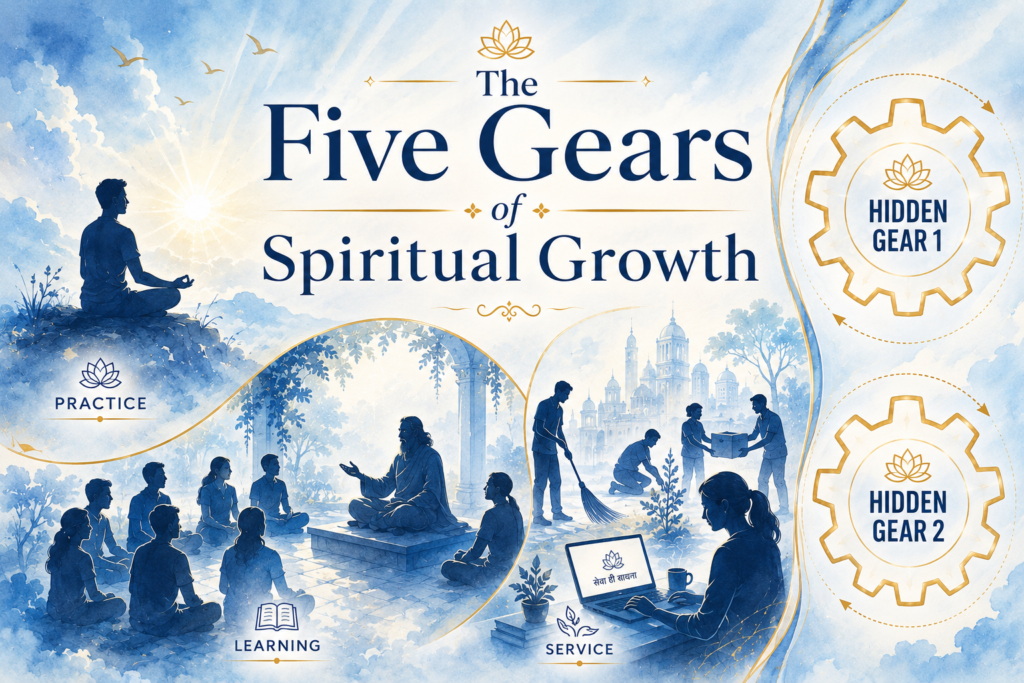
The Three S’s are often thought of as three independent spiritual disciplines. However, they are the first three gears of a much deeper system. Two additional principles complete that system, creating what I like to call the Five Gears of Spiritual Growth.
Like the gears of a vehicle, each gear has a distinct purpose and must engage in the proper sequence. You cannot begin a journey in third gear, nor can you complete a long journey by remaining in first. In the same way, spiritual growth unfolds most naturally when each gear engages at the right time, with every new gear building upon the ones before it.
The order of the Three S’s—Sadhana, Satsang, and Seva—is not arbitrary. One practice is not abandoned as the next begins. Each remains an essential part of the journey while the next is added, creating an increasingly strong and balanced foundation for spiritual growth.
The first three gears are familiar to most disciples. The fourth is often overlooked, while the fifth cannot be entered through personal effort alone. Together, these five gears help explain why some disciples simply remain on the spiritual path, while others find themselves gradually living under the quiet influence of the Guru’s grace.
Let us now examine each of these five gears in turn.
First Gear: Sadhana
The first gear of spiritual growth is Sadhana. Like the first gear of a vehicle, it provides the initial force that sets the entire journey in motion.
Reading spiritual books, attending retreats, listening to inspiring talks, or serving a noble mission can never replace the inner work of daily practice. It is through meditation, prayer, self-discipline, and the techniques given by the Guru that the disciple gradually quiets the restless mind and awakens the soul’s deeper awareness. Sadhana transforms spiritual ideals into lived experience.
Grace is ever-present, but Sadhana makes us receptive to it. Without Sadhana, spiritual life remains an inspiring idea rather than a living reality.
There is a beautiful incident from the life of Devi Mukherjee that illustrates this principle. Devi was naturally cheerful and had a habit of making light of almost everything. Paramhansa Yogananda would often remind him that excessive frivolity weakens the concentration and inner seriousness needed for meditation.
One day, after yet another reminder, Devi replied,
“Master, I cannot help it. It happens naturally. I cannot change unless you bless me.”
Yogananda answered gravely,
“My blessings are there. God’s blessings are there. But your blessings are needed too.”
What Yogananda meant was profound. God and Guru are always showering their blessings upon us, but our own sincere effort is needed to receive them. Spiritual effort does not create grace; it makes us receptive to the grace that is already present.
This is why Sadhana is the first gear. It is the foundation upon which every other aspect of spiritual life rests.
Yet no journey can remain in first gear indefinitely. Many sincere seekers meditate faithfully for years and still wonder why their progress has slowed. The reason is not that Sadhana has become less important, but that Sadhana alone was never meant to carry the entire journey. Once the foundation has been established, the next gear must naturally engage.
The second gear of spiritual growth is Satsang.
Second Gear: Satsang
Once we shift into second gear, the challenge is no longer beginning the journey, but remaining on the right path. Just as second gear allows a vehicle to move forward with greater stability and control, Satsang keeps the disciple progressing steadily and in right attunement with the Guru.
After the initial enthusiasm begins to fade, new challenges emerge. The mind becomes restless, inspiration diminishes, doubts begin to surface, and old habits slowly regain their strength. The greatest danger is not that we stop seeking God, but that we gradually begin interpreting the Guru’s teachings according to our own preferences, often without even realizing it. Small deviations, left unchecked, eventually lead us far from the path we originally intended to follow.
This is why Satsang is indispensable.
Satsang is far more than attending spiritual gatherings. It is the conscious effort to remain in the company of truth, through the Guru, his teachings, fellow disciples, and an environment that continually reminds us of our highest purpose. Paramhansa Yogananda often reminded his disciples that
“Environment is stronger than will power.”
Satsang provides that spiritual environment. It continually realigns the disciple with the Guru’s consciousness before small deviations become major detours.
If Sadhana sets the journey in motion, Satsang keeps it moving in the right direction. It renews inspiration, strengthens conviction, clarifies understanding, and gently corrects our course whenever we begin to drift. Through Satsang, the disciple learns not merely to practice the teachings, but to remain inwardly attuned to them.
Yet even this is not the destination. Satsang nourishes the disciple inwardly, but what is received inwardly must eventually find expression outwardly. Spiritual growth cannot remain confined to personal practice and inspiration alone. As love for God and Guru deepens, it naturally seeks expression through selfless action.
This is where the journey shifts into its third gear: Seva
Third Gear: Seva
The reason we now shift into third gear is that spiritual growth cannot remain an inward experience alone. Sadhana awakens us from within. Satsang keeps us aligned with the Guru’s teachings. Yet if that inner transformation never finds expression in our thoughts, actions, and relationships, our progress does not reach maturity.
At this stage, spiritual understanding must begin expressing itself in daily life. It is no longer enough to experience peace, devotion, or higher states only during meditation. Those inner gains must gradually become reflected in the way we think, act, speak, and respond throughout the day. This is where Seva becomes indispensable.
Seva is often translated simply as “service,” but within the Guru-disciple tradition, it means far more than performing helpful tasks. Seva is the conscious offering of our time, energy, abilities, and resources to the Guru’s mission. Through that offering, the Guru is given a greater opportunity to mould, refine, and uplift the disciple.
Offering of Effort
The most natural place for this transformation to begin is in an environment that supports and reinforces spiritual growth. What better training ground could there be than serving in the Guru’s mission alongside fellow disciples?
Here, the disciple gradually learns to act, not according to personal likes, dislikes, habits, or impulses, but in increasing attunement with the Guru’s guidance.
Our own will is often shaped by years of conditioning, personal preferences, and ego-driven desires. The Guru’s will, however, is free from these limitations. As we learn to align our thoughts and actions with the Guru’s guidance, we gradually develop the ability to think more clearly, act more wisely, and respond more selflessly.
Unlike Sadhana, where we consciously work on ourselves through inward practice, Seva transforms us by teaching us how to act and interact in harmony with the Guru’s guidance. Every interaction, every responsibility, and every challenge becomes an opportunity for the Guru to reveal and refine hidden tendencies that meditation alone may never expose. Through these daily experiences, the lessons cultivated in meditation are tested, strengthened, and gradually woven into every aspect of life.
Over time, this way of living naturally extends beyond the Guru’s work and begins to permeate every aspect of our lives. The patience learned while serving, the humility developed through cooperation, the selflessness cultivated by putting the mission before personal preference, and the growing habit of seeking guidance rather than reacting impulsively gradually become part of our character. Even in environments far less conducive to spiritual growth, the disciple begins to respond differently because the Guru’s training has become inwardly established.
Yet this is only one dimension of Seva.
By offering our time, effort, and abilities to the Guru’s mission, we also give the Guru a far greater opportunity to purify, refine, and uplift our own energy. Seva therefore becomes far more than an act of helping. It becomes one of the Guru’s most powerful instruments for transforming the disciple.
There are countless ways to offer Seva. Some serve by teaching, counselling, maintaining an ashram, organising events, or helping fellow seekers. Others contribute through professional skills such as writing, editing, translating, accounting, technology, administration, music, design, or countless other forms of dedicated service.
Even simple acts in today’s digital world can become meaningful Seva. Sharing an article, leaving a thoughtful comment, helping someone discover authentic spiritual teachings, or quietly supporting the spread of the Guru’s message may touch the life of a sincere seeker in ways we may never know.
The Guru does not measure whether our service is large or small, visible or unnoticed. He looks only at the consciousness with which it is offered. What transforms the disciple is not the outward task itself, but whether it is performed with sincerity, humility, devotion, and the desire to serve as an instrument of the Guru’s work.
Offering of Stored Energy: Money as Resource
Offering our effort is one expression of Seva. Another is the offering of our money to the Guru’s mission.
Money is far more than a medium of exchange. It represents our stored life energy—the time, effort, intelligence, and abilities we have invested in our work. Through our labour, our energy is converted into money, making it another part of ourselves that we can consciously offer to God through the Guru’s work.
I remember once losing a significant amount of money. A friend remarked that one of the easiest ways for karma to be worked out is through money. The more difficult ways are often through our relationships or our health. That simple observation stayed with me because it completely changed the way I looked at money.
If money is condensed life energy, then offering it to the Guru’s mission is far more than making a financial contribution. Just as offering our effort through Seva allows the Guru to refine our actions, offering our money gives the Guru another means through which our energy can be purified and directed toward our spiritual growth. The outer form may be different, but the inner principle remains the same: the sincere offering of ourselves.
Yet the transforming power of Seva does not arise merely from offering our effort or our money. Its deeper significance lies in becoming an instrument through which the Guru’s work is carried into the world.
Becoming a Channel of Grace
Paramhansa Yogananda said,
“The channel is blessed by what flows through it.”
As we become channels for the Guru’s work, we are transformed by the divine grace flowing through us.
There is a beautiful story that illustrates this truth.
A farmer once invited a priest to visit his farm. Proud of all the improvements he had made, he took the priest around the property, showing him the flourishing fields, the healthy crops, and the well-maintained land.
At every stop, the priest smiled and said,
“What wonderful work God has done.”
After hearing this several times, the farmer, irritated that his own hard work was being overlooked, finally exclaimed,
“Father, you should have seen this land when God had it all to Himself!”
The priest wasn’t diminishing the farmer’s effort. He was pointing to something much deeper: it was God’s grace working through the farmer that made the transformation possible.
This is precisely how God and Guru work. They accomplish their work through willing channels. In serving the Guru’s mission, we become instruments through which divine grace can flow. And before that grace reaches those we serve, it first flows through us. As Master reminded us, “The channel is blessed by what flows through it.”
There is another beautiful incident from the life of Swami Kriyananda that illustrates this same truth.
Once, Swami Kriyananda felt an overwhelming wave of divine love flowing from Paramhansa Yogananda. Deeply moved, he prayed,
“Teach me to love you as you love me.”
Later, as Yoganandaji stood up to leave the room, he looked deeply at Swamiji and replied to his unspoken prayer,
“How can the little cup hold the whole ocean?”
The meaning was profound. The limitation was not the Guru’s love, but the disciple’s capacity to receive it.
Spiritual growth is, in many ways, the gradual expansion of our capacity to receive and hold ever greater divine energy. Every sincere act of Seva expands that capacity a little more, allowing the disciple to become an ever clearer and more receptive channel for the Guru’s grace.
Understanding the transforming power of Seva naturally raises another question. If Seva transforms us through offering, does it matter where that offering is made? Or does every act of service produce the same spiritual result?
Does Every Act of Service Become Seva?
When disciples first hear about offering Seva, many naturally think, “Perhaps I should volunteer at a blind school or another charitable organization.”
That is a noble thought, and such acts of service unquestionably bring benefit to others while generating good karma. But good karma and spiritual transformation are two different goals, achieved through different means.
By this stage of the journey, the disciple is seeking to consciously accelerate spiritual evolution.
This is why the Masters consistently encouraged disciples to offer Seva in service of the Guru’s mission. Let us understand the deeper spiritual principle behind that guidance. The answer lies in understanding what Seva is truly designed to accomplish.
The Guru’s foremost responsibility is the spiritual awakening of the disciple.
Every instruction the Guru gives, every meditation technique He teaches, every challenge He allows us to face, and every opportunity for Seva He provides has one central purpose—to hasten the disciple’s journey back to God.
When we serve according to our own ideas, we naturally choose forms of service that appeal to our temperament, talents, and preferences. But when we serve the Guru’s mission, we place ourselves under the guidance of the Guru who sees far beyond our present understanding.
The Guru knows precisely which experiences will strengthen us, which responsibilities will expose hidden weaknesses, which situations will develop humility, patience, courage, or selflessness, and which opportunities will draw us closer to God.
Seva, therefore, is not simply about doing good work. It is about willingly placing ourselves where the Guru can work most effectively upon us. This is why the Guru’s mission holds such unique significance. When understood in this light, Seva is no longer simply something we do for the Guru. It becomes one of the Guru’s tools for transforming us.
Yet even within the Guru’s mission, not every disciple receives the same transforming power from Seva. What makes the difference is not the work itself, but the attitude with which it is performed.
Respecting the Channel of Grace
Understanding Seva also requires understanding the channel through which the Guru works.
In larger spiritual organizations, a subtle misunderstanding can sometimes arise. A disciple may receive initiation, guidance, and spiritual nourishment through a particular Acharya, centre, or unit, yet choose to offer service or financial support elsewhere, assuming that since everything belongs to the same organization, the destination does not matter.
Outwardly, this may seem reasonable. Spiritually, however, something deeper is taking place.
The Guru does not guide disciples randomly. Grace flows through specific channels. The Acharya, centre, or unit through which the Guru has chosen to guide a disciple often represents a karmic relationship that is most conducive to that disciple’s spiritual growth. By honouring that channel, the disciple completes the cycle of giving and receiving that the Guru Himself has established.
This is the deeper meaning behind the saying,
“Give to the channel that inspires you.”
Here, inspiration does not simply mean personal preference or emotional attraction. It refers to the channel through which the Guru’s grace, guidance, and spiritual nourishment are actually reaching you. For some disciples there may be one such channel; for others, there may be several. In every case, the flow of grace is naturally met with a corresponding flow of gratitude, service, and offering.
Respecting the channel of grace is, therefore, an integral part of Seva. It reflects the disciple’s recognition that the Guru is working through a specific relationship established for his or her spiritual growth.
Yet the significance of Seva extends even further. In the present age of Dwapara Yuga, Seva assumes a role unlike any previous age, making it one of the most powerful accelerators of spiritual evolution.
Significance of the Current Ascending Dwapara Yuga
Seva assumes an even greater significance during the present transition from Kali Yuga to the ascending Dwapara Yuga.
During this period, humanity is gradually emerging from the inertia, misconceptions, and tamasic influences of the previous age. Such a transition requires tremendous spiritual effort. The Guru’s mission is not only to guide individual disciples but also to help humanity move into a higher state of consciousness.
When disciples consciously participate in that mission through Seva, they become part of this work of transformation. By becoming channels through which the Guru helps humanity overcome the inertia of the previous age, they receive an additional acceleration in their own spiritual evolution. This is similar to “nitrogen boost” to acceleration.
Having understood the role of Sadhana, Satsang, and Seva, one final question remains. Why do two disciples, following the same Guru and faithfully practising the Three S’s, often grow at very different rates?
The answer begins with the fourth gear.
Fourth Gear: Right Attitude
The fourth gear of spiritual growth is Right Attitude. It is the inner consciousness with which we practise Sadhana, participate in Satsang, and perform Seva. Without the right attitude, even sincere spiritual practices lose much of their transforming power.
Swami Kriyananda defined it beautifully:
“The ability to live more inwardly is the hallmark of right spiritual attitude.”
What does it mean to live inwardly?
It does not mean withdrawing from the world or living the life of a hermit. It means living in continual attunement with higher consciousness. It means approaching every action as an offering to God and Guru rather than as a means of achieving personal gain.
Whenever our attention is fixed primarily on the results of our actions, the ego naturally becomes stronger. We become attached to success and disappointed by failure, gradually losing our inner attunement. Right attitude shifts our focus from results to offering. We do what is right because it is right, leaving the results to God.
Right attitude also means overcoming our personal preferences and doing what is right for our higher spiritual good. It means listening to the Guru’s guidance, even when it differs from our own preferences. Too often, the Guru’s guidance is drowned out by the voice of our likes, dislikes, and personal opinions.
This is where disciples often make the mistake of thinking that Seva is doing the Guru or His channel a favour. The opposite is true. The Guru does not need our service. If necessary, He could accomplish His work through countless other means. Seva is offered not because the Guru needs workers, but because disciples need transformation.
For this reason, Seva is a privilege, not an entitlement.
The opportunity to serve is earned through sincerity, humility, and an intense longing to participate in the Guru’s work. As that longing deepens, opportunities for Seva naturally begin to appear. The disciple serves with gratitude, recognising that every opportunity for Seva is another opportunity to grow.
The Guru cannot be deceived. He responds not to outward activity, but to the consciousness behind it. Ultimately, it is this inner attitude that determines how deeply all the previous gears transform us.
Fifth Gear: Flowing with Grace
After we have sincerely worked on the first four gears over a period of time, something remarkable begins to happen. Without consciously trying, we naturally shift into the fifth gear—Grace.
Many years ago, a senior disciple of Paramhansa Yogananda told me, “It becomes easier after ten years.”
At the time, I didn’t understand what he meant. But over the years, I gradually discovered the truth of those words.
Like learning any new skill, spiritual living requires practice. In the beginning, we consciously practise Sadhana, seek the support of Satsang, serve through Seva, and strive to maintain the right spiritual attitude. It requires effort. We forget, we falter, and we begin. Gradually, however, what once required conscious effort becomes increasingly natural. The practices slowly become part of who we are.
I was reminded of the familiar saying,
“Take the world in your stride.”
Over time, I found myself taking the world in the strides of grace.
Situations that once disturbed me became easier to face. Challenges no longer shook my inner balance as they once did. Living with grace gradually became as natural as ordinary living.
This is the fifth gear.
It cannot be reached through willpower alone. Rather, it unfolds naturally when the first four gears have become our way of life. Grace is no longer something we occasionally experience. It becomes the quiet current that carries us forward.
Perhaps this is why so few seekers experience deep, lasting transformation. The journey is not sustained by effort alone, nor by knowledge alone, but by allowing each gear to engage in its proper time until the disciple gradually comes under the transforming influence of grace.

Amrita Ghosh
YogiEvolve

Your first step toward inner awakening — a yogi’s guide to transforming energy & life.
Based on the teachings of Paramhansa Yogananda.
Now Available at Amazon Kindle
Deepen Your Practice with the Companion Workbook
A guided companion workbook designed to deepen your experience of A Beginner’s Guide to Prana or Life Force Mastery.
Explore More Post from the Author
The Five Gears of Spiritual Growth
The Five Gears of Spiritual Growth I watched thousands of seekers enter a spiritual organization with great enthusiasm. Of those thousands, perhaps only two or three remained steadfast, and even among them, perhaps only one experienced deep, sustained spiritual transformation. Why do so many sincere seekers begin with dedication, yet
Kriya Yoga: The Forgotten Science of Self-Realization
Kriya Yoga is the forgotten science of Self-realization that has largely remained outside mainstream understanding for over 2,500 years. This article explores what was lost, why reviving it in today’s world is so challenging, and why preserving Master’s teachings without compromise lies at the heart of YogiEvolve’s mission.
Why Some People Seem to Fail in Spiritual Practice
Why do some people seem to progress rapidly on the spiritual path while others struggle, stagnate, or drift away? Drawing from years of working with students of Kriya Yoga under my Guru’s guidance, I explore a deeper perspective on spiritual growth, one that challenges our assumptions about success, failure, and
A Journey into the Inner World of a Kriya Yogi
This is a glimpse into the inner world of a new Kriya Yogi, as he gradually discovers the hidden siddhis, subtle powers, and inner wonders that unfold along the path of sincere spiritual practice.
The Purpose of Ego in Spiritual Evolution
What if the ego is not something to be overcome, but something that must be developed, directed, and spiritualized? Drawing on the teachings of Paramhansa Yogananda, this article explores the deeper meaning of Ahamkara and why individuality plays an essential role in the soul’s journey toward God-realization.
Horizontal Growth and Vertical Spiritual Evolution
Most seekers assume that spiritual power and spiritual growth are the same thing. But not all spiritual growth moves in the same direction. Some paths increase power without increasing wisdom, while others lead toward deeper alignment with Dharma and Divine consciousness. Understanding this distinction may be one of the most